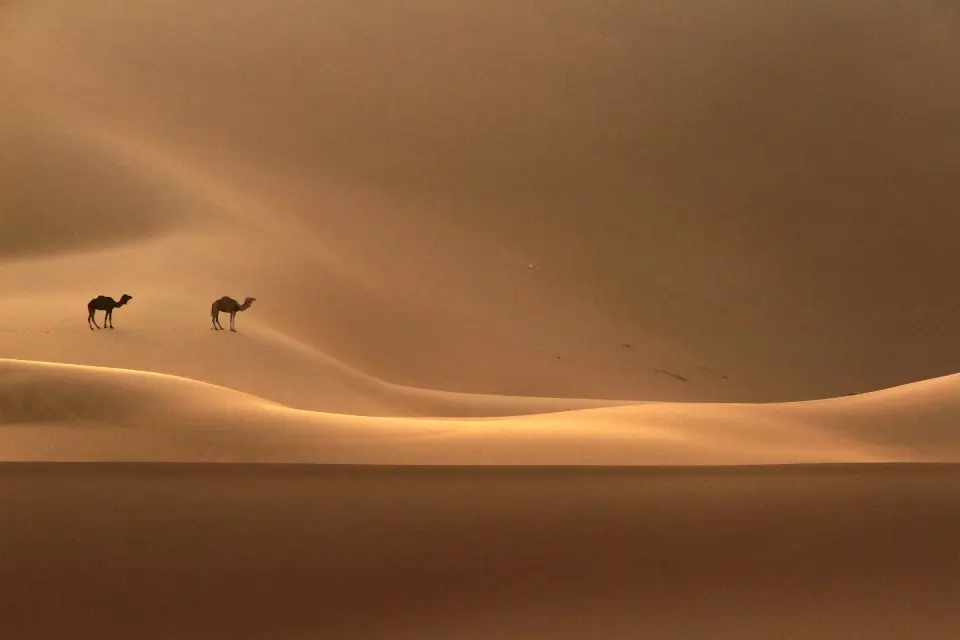
Looking for Chigaga in a shared group? Start with the actual route
Jamou · Wikimedia Commons · CC BY 3.0 · Image adapted.

Finding a shared Sahara trip is easy until you specify Erg Chigaga. Search for three-day desert tours from Marrakech and Merzouga appears repeatedly; search for Chigaga and many offers switch to private vehicles or ask you to request a quotation. The route beyond M’Hamid needs more than a road transfer. It needs an off-road vehicle, a desert driver and a group whose dates fit the same journey.
DesertBrise offers that shared option at €200 per person, with departure confirmed from four paying travelers on the same date. Our route spends the first night in Agdz, then follows the Draa Valley through Zagora toward M’Hamid and the Chigaga dunes. The second night is at the desert camp. You can request a place alone or as a couple; four is the minimum for the whole departure, not the number you must bring yourself.
The appeal is specific: reach the dunes beyond the paved road without reserving the entire journey privately. Our family roots are in M’Hamid, and this southern route belongs to the region we know. See the shared Chigaga tour and ask about your date. Below is the journey itself: what changes at each stop and why those places belong together.
The journey includes a visit to Aït Ben Haddou, a pottery-workshop visit and the old Quranic school at Tamegroute, and time to discover M’Hamid before the desert tracks. In the desert, the program also brings you into contact with nomadic hosts and shows how sand bread is made. The camel ride is included; quad biking and buggy rides are optional experiences arranged and priced separately.
Three days, two different nights and a genuine desert crossing
Day one connects Marrakech with the High Atlas, Aït Ben Haddou, Ouarzazate and Agdz. It is a journey across landscapes, ending near the upper Draa palm groves rather than pushing farther south to sleep in Zagora. Day two continues down the valley, passes the Zagora and Tamegroute corridor and reaches M’Hamid. Here the paved approach gives way to the specialist 4×4 crossing to Chigaga.
Day three leaves the dunes toward Iriki and Foum Zguid when track conditions allow, then returns through the Taznakht and Ouarzazate corridor to Marrakech. This creates a southern loop rather than treating every mile as an out-and-back transfer. The driver can change the desert exit according to conditions; the map explains the route, not a promise to force a particular track.
There is substantial driving, especially on the return. Choosing Agdz for the first night gives the oasis region its place in the story, but it also leaves the onward valley drive for the following morning. This remains an active three-day trip. If you want an entire day at the dunes without packing up, ask about a longer program instead of expecting three days to contain the rhythm of a week.
The High Atlas and Tizi n’Tichka: the landscape changes before the Sahara
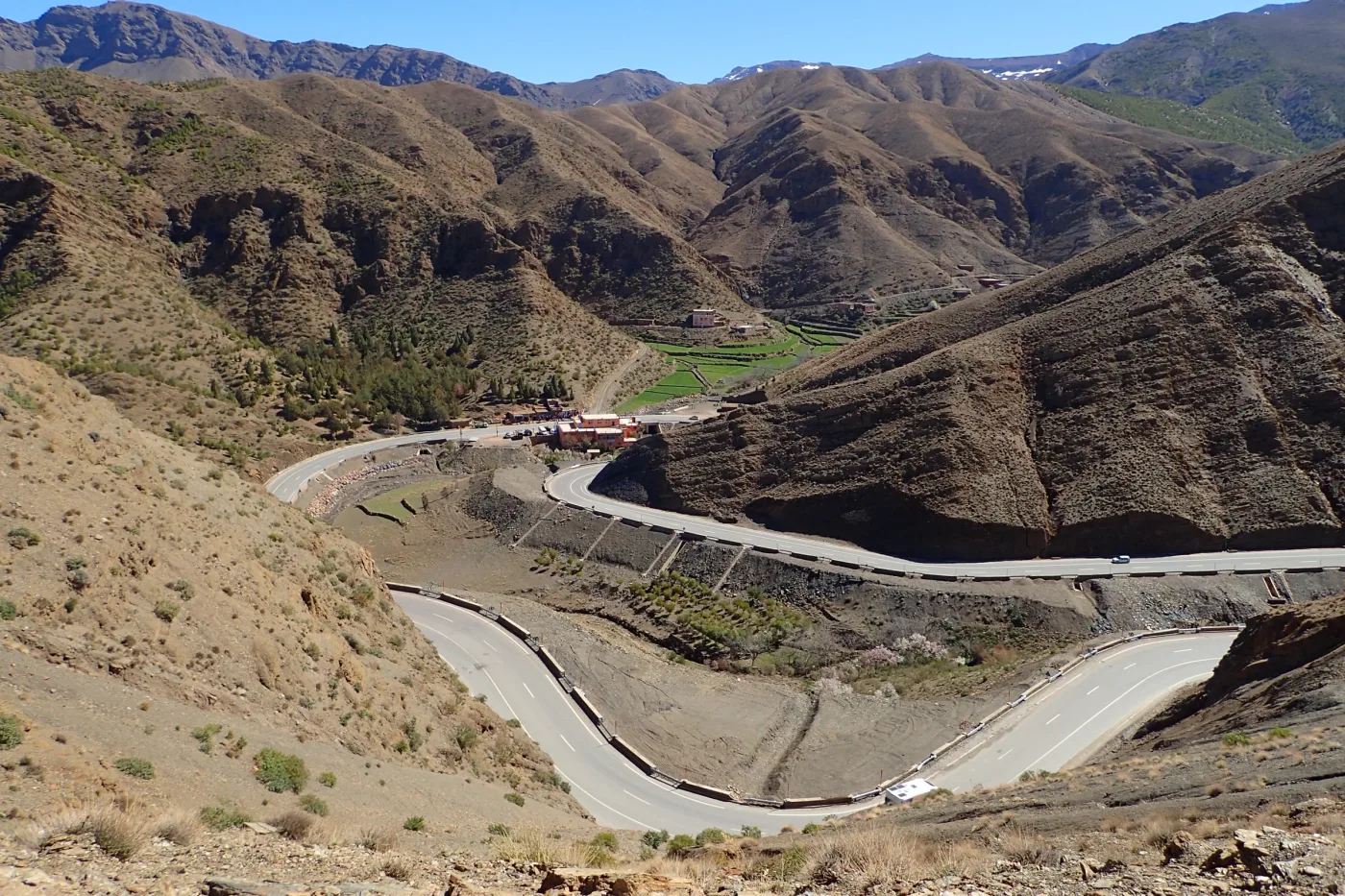
N9 mountain road in the High Atlas on the route from Marrakech. Krzysztof Ziarnek (Kenraiz) · Wikimedia Commons · CC BY-SA 4.0 · Image adapted.
_kz03.jpg)
Marrakech is still behind you when the road starts climbing into the High Atlas. The built-up surroundings give way to slopes, villages and a road that folds around the mountains. Tizi n’Tichka is the crossing between the Marrakech side and the southern corridor. Its importance on this trip is not just the pass photograph: it explains how far the landscape has to change before you reach a Saharan camp.
The group uses suitable viewpoints and comfort breaks along the way. A shared departure needs a common rhythm, so the day works better with purposeful stops than with an unlimited list of detours. Keep a small bag accessible for layers and personal essentials. Weather and light can be different from Marrakech, and the mountain section deserves attention rather than being dismissed as the dull part before the dunes.
As the route descends on the southern side, the scenery opens and the colors shift toward the earth-built settlements associated with the Ouarzazate region. This first transition gives the next stop context. Aït Ben Haddou is not an unrelated attraction attached to a desert booking; it belongs to the history of movement across these landscapes. The road, the settlements and the oasis corridor are successive parts of the same journey south.
Aït Ben Haddou and Ouarzazate: reading the southern gateway
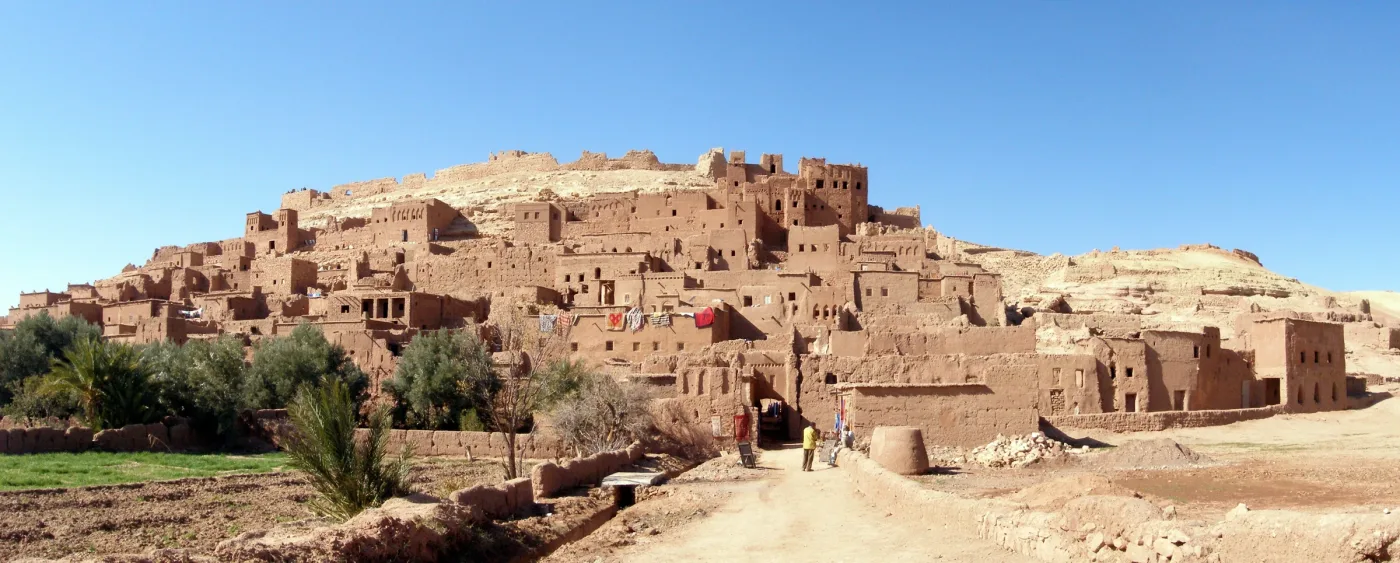
The visit to Aït Ben Haddou is a planned stop on the first day, with time to explore the ksar before continuing through Ouarzazate toward Agdz.
Earthen ksar of Aït Ben Haddou, the heritage stop on Day 1. China Crisis · Wikimedia Commons · CC BY-SA 2.5 · Image adapted.

Aït Ben Haddou is a ksar, a fortified settlement, rather than simply one isolated kasbah. Its clustered earthen buildings rise together above the surrounding landscape. Looking at the lanes, walls and elevated position helps explain why travelers stop here even on a compact itinerary. The place gives architectural form to the relationship between settlement, protection and the routes connecting southern Morocco with Marrakech.
The UNESCO description of Aït Ben Haddou provides the heritage background. During the stop, allow yourself to look beyond the familiar panoramic view: the texture of the earth walls and the way the buildings fit the slope are part of its character. Visiting takes place on foot, with uneven surfaces and climbs depending on how far you choose to go. Discuss any access needs before departure.
Ouarzazate comes next as the practical link between the mountain crossing and the route toward Agdz. It is known for its film connections, but passing through does not automatically mean a studio tour or a paid kasbah visit. On this three-day shared journey, protecting the time for Agdz and the next day’s desert approach matters. Visit time at Aït Ben Haddou is included; a private local guide and any paid entries are separate unless expressly listed in your confirmation.
Agdz: an oasis evening below Jbel Kissane
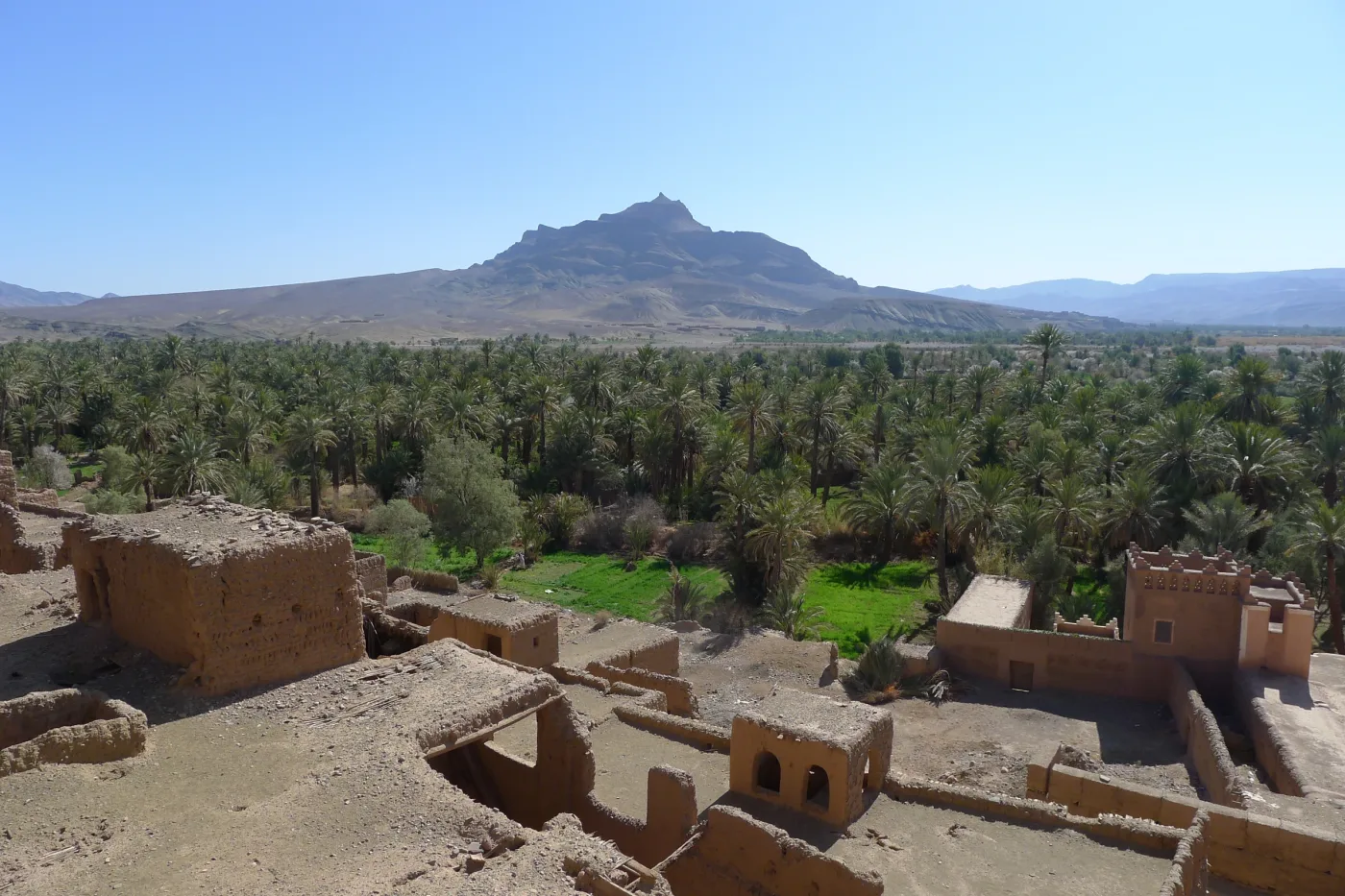
Jbel Kissane, palms and earthen buildings at Agdz, the first-night area. Dromedar61 · Wikimedia Commons · CC BY-SA 3.0 · Image adapted.

The road from Ouarzazate crosses another mineral landscape before opening toward Agdz and the Draa Valley. The contrast is striking because cultivation is concentrated rather than spread evenly over the countryside. Palms and settlement follow the places where life can be sustained. The profile of Jbel Kissane gives the Agdz landscape a recognizable outline, and the valley starts to feel like a region with its own identity rather than a road to somewhere else.
This is where we spend the first night. Agdz gives the first evening a setting of its own in the upper Draa Valley. The purpose of staying here is to experience the upper valley as part of the journey before continuing south. Dinner and breakfast accompany the overnight. The actual property and room allocation are confirmed for your departure; we do not use a landscape description to imply a named lodge or an unconfirmed room category.
If arrival time and your confirmed program allow a short look around, keep it respectful of homes and cultivated land. The Tamnougalt area belongs to this valley’s architectural context, but a guided visit there should be agreed rather than assumed. Most of all, let Agdz remain a place to arrive. The first evening does not need another rushed excursion to justify its inclusion before the longer onward day.
The Draa Valley, Zagora and Tamegroute: the inhabited road south
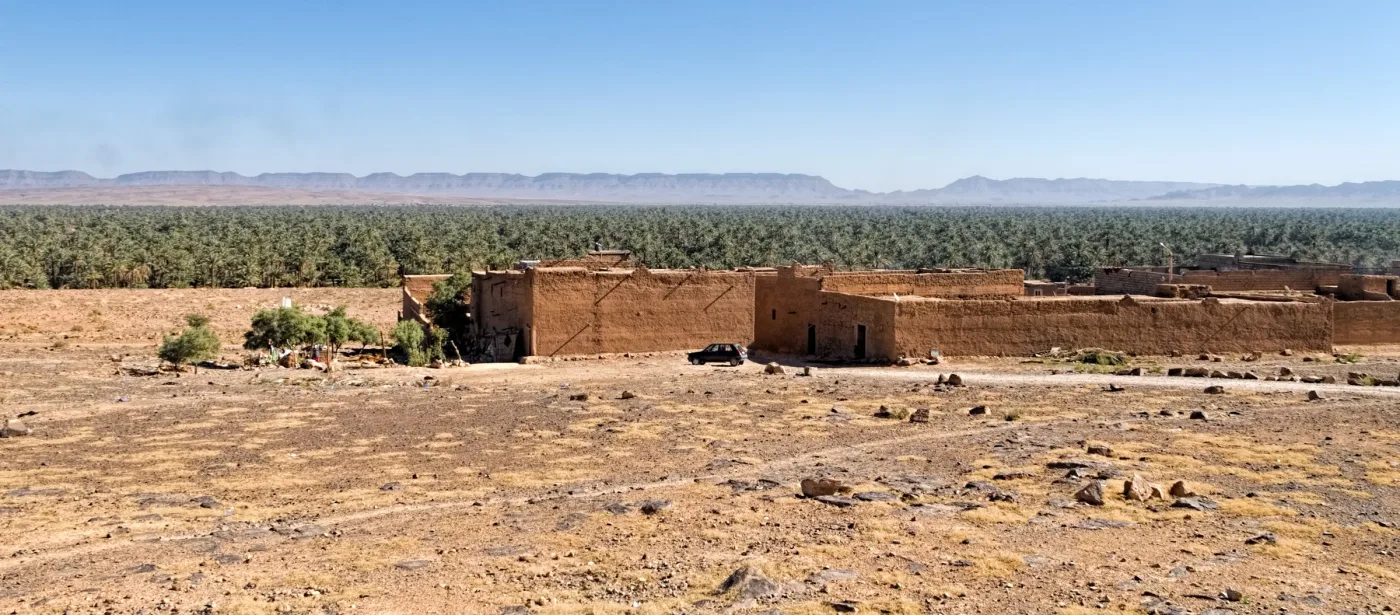
Palm grove and earth-built settlement in the Draa Valley. Dan Lundberg · Wikimedia Commons · CC BY-SA 2.0 · Image adapted.

From Agdz, the second day follows the valley toward Zagora. Palms, cultivated strips, earth-built settlements and dry slopes appear in changing combinations. The interest is in that relationship: the oasis is a lived landscape, not simply a green backdrop for the desert. Water availability and season affect its appearance, so do not expect every stretch to resemble the same lush photograph throughout the year.
Zagora is an onward town on this itinerary, not the first-night stop. It marks progress down the Draa corridor before M’Hamid and the remote dune field. A short two-day tour sold under the name Zagora should not be confused with reaching Chigaga. Our route continues beyond the town and beyond the smaller desert-edge landscapes because the destination is the more distant dunes reached by 4×4.
Zagora is followed by the Tamegroute visit described below, before continuing toward M’Hamid. These cultural stops give the second day more substance than a transfer between an oasis hotel and a dune camp.
Tamegroute: visit the pottery workshop and the old Quranic school
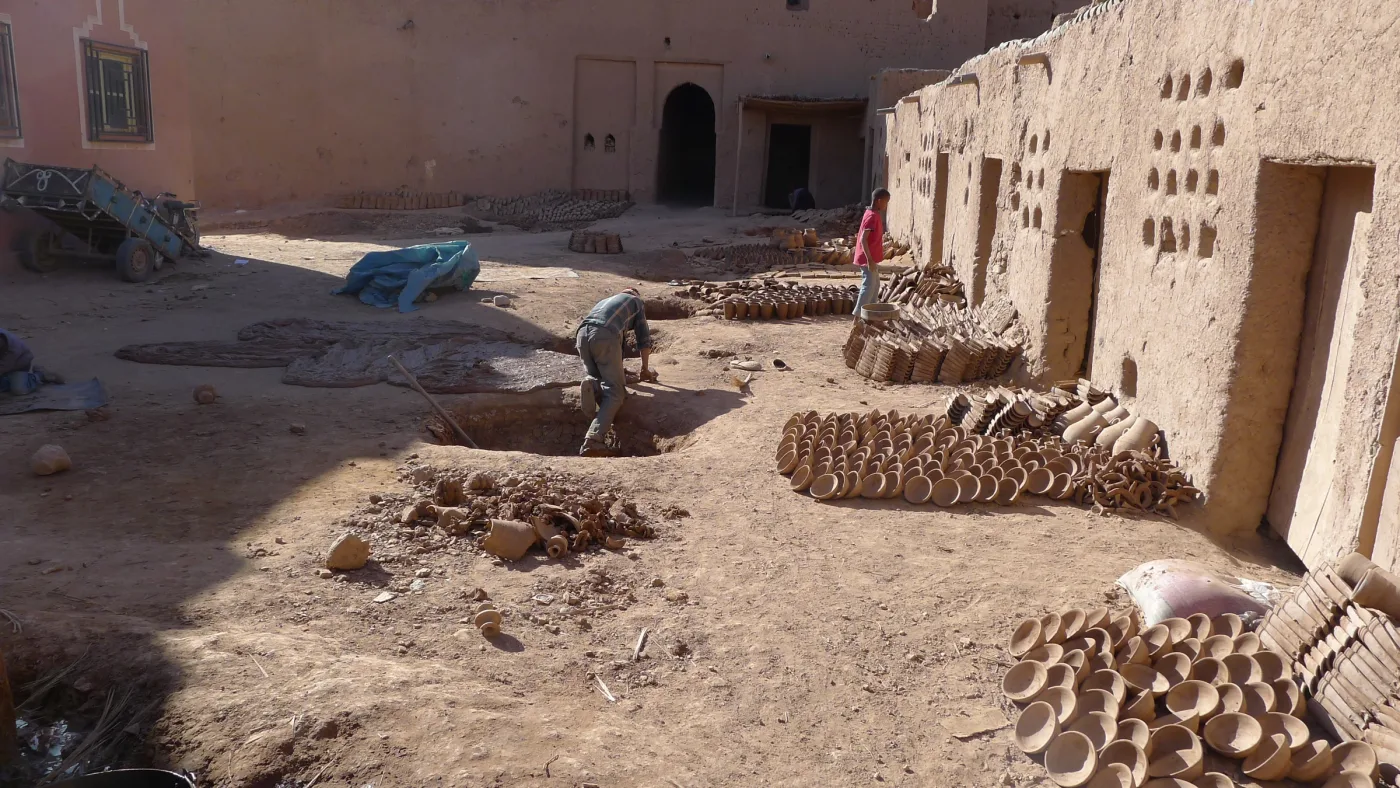
Artisan at a pottery workshop in Tamegroute, photographed in 2012. Bernhard Holub · Wikimedia Commons · CC BY-SA 4.0 · Image adapted.

At Tamegroute, stop at a pottery workshop to see the craft behind the distinctive green ceramics. The visit is to a working place: look at the clay, the shapes and the stages the artisans are carrying out that day. It is a chance to understand the objects you see across Morocco, rather than merely stop at a roadside display. Visiting a workshop does not imply a full hands-on pottery course or a required purchase.
The old Quranic school adds another side of Tamegroute. Its tradition of religious learning belongs to the village’s wider scholarly heritage, associated with the Nasiriyya complex and manuscript collections. Follow the local arrangements for the visit and respect any rooms or religious spaces that are not open. A school, a manuscript library and a place of worship are related parts of that history, but they are not interchangeable interiors or a promise of unrestricted access.
M’Hamid: where the road journey becomes a 4×4 desert approach
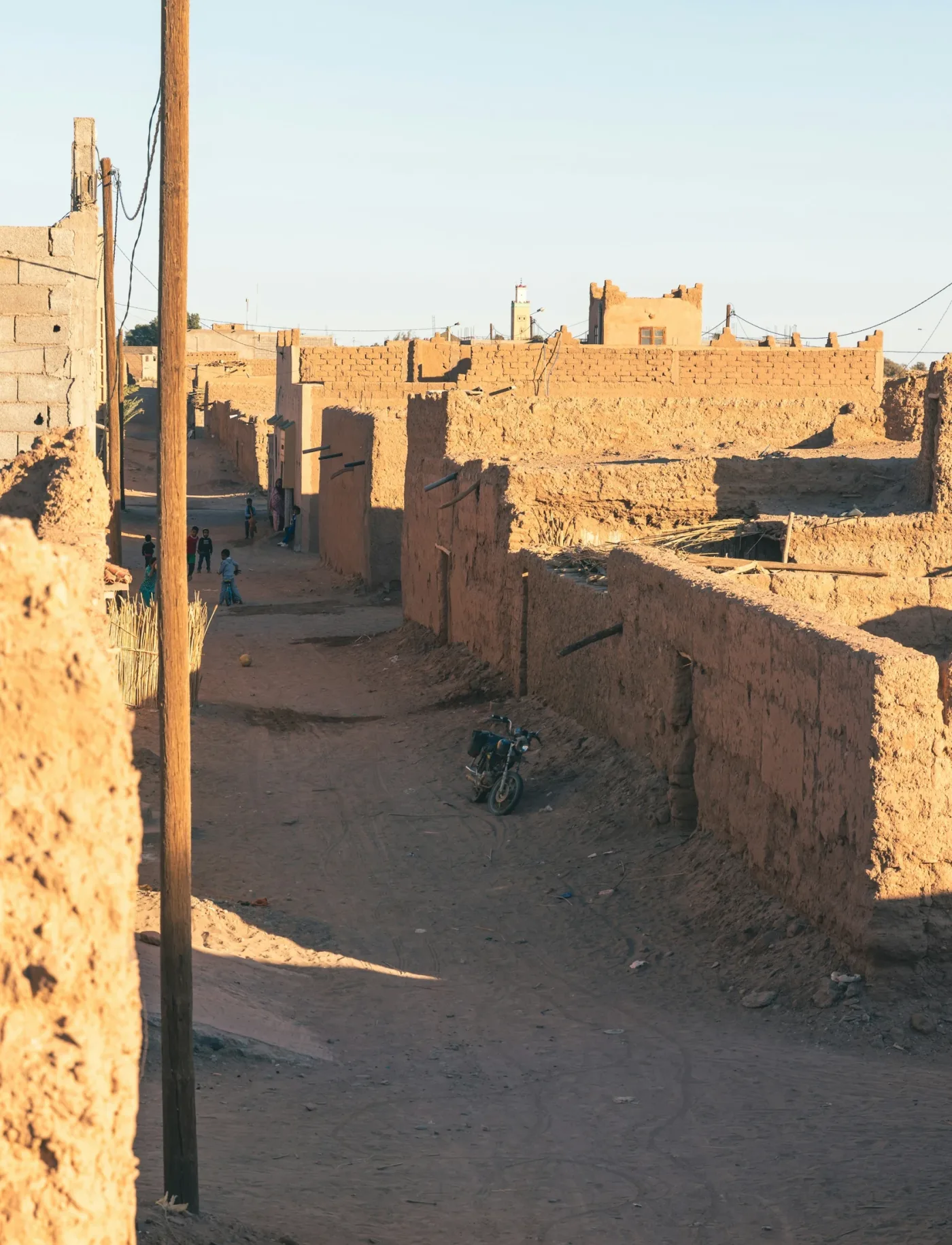
Village street in M’Hamid El Ghizlane, the gateway before the desert crossing. Armands Brants · Unsplash · Unsplash License · Image adapted.
The program includes visiting M’Hamid El Ghizlane, the last village before the desert tracks on this route. Take time to notice the change from the inhabited Draa corridor to the gateway for the dunes. The village is not a substitute for Chigaga: it is the place that makes the onward crossing possible. For DesertBrise, it is also our family’s home region, giving this stop a direct connection with the people organizing your journey.
The specialist desert 4×4 and driver are included in the package. You are not taken as far as M’Hamid and then asked to buy the essential dune transfer as an unexpected extra. The landscape beyond can include hammada, sandy sections and broad open ground. The driver chooses a workable line according to sand, wind and conditions. There is no normal paved highway to the camp, and a track should not be treated as a fixed road timetable.
This approach helps explain why a shared Chigaga seat can take more planning than a generic shared desert booking. The road group and the desert section must fit together on the same date. You still need a confirmed departure, even though you are willing to share. Once underway, the change from villages to open ground lets the remoteness arrive gradually, before the dunes finally become the dominant feature ahead.
Erg Chigaga: the included camel ride and the night among dunes
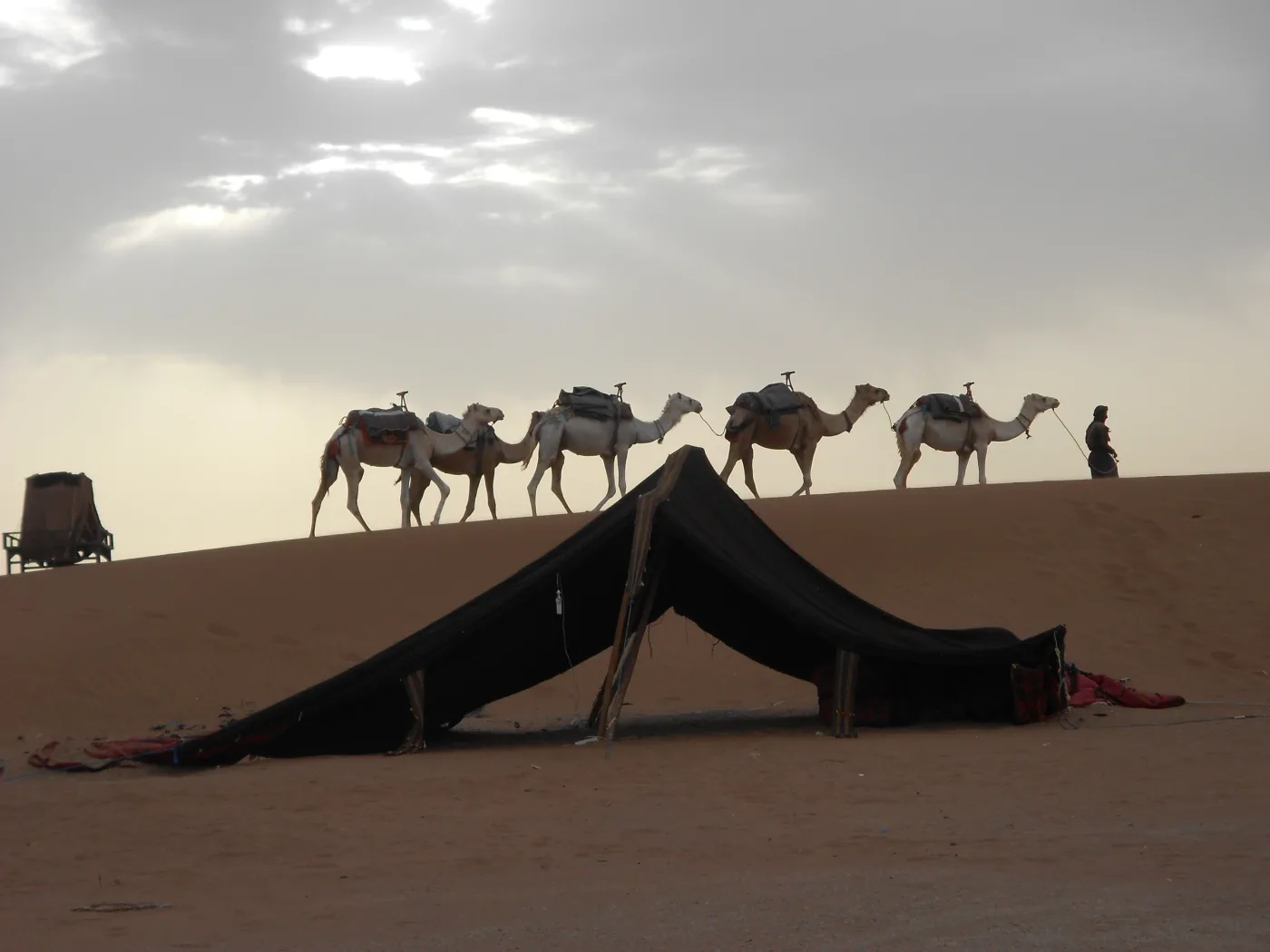
Archival photograph of a camp and dromedaries identified as Erg Chegaga by the source; not the booked accommodation. Angela Stefanoni · Wikimedia Commons · CC BY 3.0 · Image adapted.

The dune field is the reason for continuing beyond M’Hamid. After the flatter and stonier approach, the shapes of the sand give the landscape a different scale. The evening is not just a final photograph before turning back: the group stays at camp, with dinner and breakfast included. You have a night in this setting rather than a distant view of dunes at the end of a road day.
The camel ride is included. It belongs to the Chigaga portion of the journey, not to a substitute stop at smaller dunes along the way. If you prefer not to ride, tell us before departure so the arrangements can be handled accordingly. There is also room for a short walk and for watching the light change. The experience does not require reaching the highest crest or making every minute into an activity.
Camp choice and tent allocation are confirmed before booking. A photograph of a camp at Chigaga shows the right region, but it is not proof of your tent’s facilities. Ask about beds, bathrooms and any essential requirements. In the evening, darkness and weather shape what you can see; stars and particular sunset colors cannot be guaranteed. The appeal is the overnight itself, with the dunes close enough to become your surroundings rather than a stop you immediately leave.
Visit nomadic hosts and see bread baked in the sand
The desert program includes a visit with nomadic hosts and a demonstration of sand-bread preparation. This gives the journey a human connection beyond the dunes: an opportunity to ask about life and movement in the region through the local team. The meeting is arranged with the hosts rather than treated as an encounter you can demand at any tent. Ask before taking photographs and let the conversation follow the welcome offered.
Watching sand bread being made is a practical way to understand desert cooking. The team prepares the dough and demonstrates baking with the heat of the sand and embers, then uncovers and cleans the bread. The sequence is fitted into the desert program with the people demonstrating it; it is not a separate full-day cooking class. It adds a clear local experience to the 4×4 crossing, camel ride and camp night.
Quad biking and buggy rides: optional ways to explore
If you want a motorized activity in the Erg Chigaga desert area, ask about quad biking or a buggy ride when reserving. These are optional activities, quoted separately from the €200 shared package; the included camel ride is a different experience. Confirm the actual starting point, route, duration, availability and participation requirements with the team.
A three-day route still needs time for the valley, the dunes and the long return. We coordinate any requested ride with the group schedule rather than promise unlimited activities on arrival. The final confirmation should say which activity you have chosen and when it fits.
Iriki, Foum Zguid and Taznakht: the return has its own landscape
The third day begins by leaving the dune field in the 4×4. When conditions permit, the route crosses toward the Iriki side and Foum Zguid. The contrast with the dunes is part of the interest: open lake-basin country and mineral expanses reveal that the Sahara is not one continuous sea of sand. Ground and weather decide the practical line, and the desert driver can choose an alternative exit.
Foum Zguid is the point where this planned western exit reconnects with ordinary roads. It is a meaningful change after the track, not simply another name on an itinerary. The route then runs through the Taznakht area, associated with weaving and carpets, before reconnecting with the Ouarzazate and High Atlas corridor. Passing through a craft region does not impose a shopping stop or include a carpet purchase; specific visits belong in the agreed plan.
Marrakech is reached after a long final journey with breaks. Do not schedule a flight or fixed evening activity immediately afterward. This is the practical cost of reaching Chigaga in three days, and explaining the interesting stops does not make that distance disappear. A night in Marrakech after the tour protects the ending. You can watch the last landscape changes instead of measuring the whole return against an unrealistic onward connection.
What the shared package includes for €200
The shared rate covers road transport with fuel and a Moroccan driver, the specialist desert 4×4 with driver, Marrakech pickup and return at the confirmed accessible point, the Agdz overnight and the Chigaga camp overnight. Both stays include dinner and breakfast, giving two dinners and two breakfasts in total. The Chigaga camel ride and scheduled visit time at Aït Ben Haddou are included in the program.
Lunches, drinks, unlisted meals, optional private local guides and applicable paid entries are separate unless your confirmation states otherwise. Neither private bathrooms nor a particular lodge should be inferred from the price. The agreed room and tent arrangements matter more than a vague accommodation adjective. Keep the distinction between included route stops, places passed through and additional interior visits clear when comparing proposals.
Four paying travelers on the same date confirm the shared departure. That is a minimum, not a published maximum or a requirement to bring your own four-person party. If the date is still gathering participants, ask about alternatives before committing your whole holiday around it. The shared-tour collection can help compare formats, but your booking must specify Chigaga and the Agdz-first-night route described here.
Request the Agdz–Chigaga shared departure
Send DesertBrise your preferred dates, number of travelers and Marrakech accommodation. Mention whether you are alone, a couple or friends, and state any essential room, tent or food requirements. Ask whether the departure is confirmed and request the written route with Agdz on the first night. We will explain the group arrangement and the complete services before you reserve.
Ask for a place on the shared three-day Erg Chigaga tour. Choose it for the whole progression: the Atlas crossing, Aït Ben Haddou, an Agdz evening, the Draa corridor, M’Hamid, the desert tracks and the camp night. Sharing makes that journey accessible without booking it entirely privately. Its strength is this particular route and its local organization, with enough clarity that you know what you are traveling south to experience.