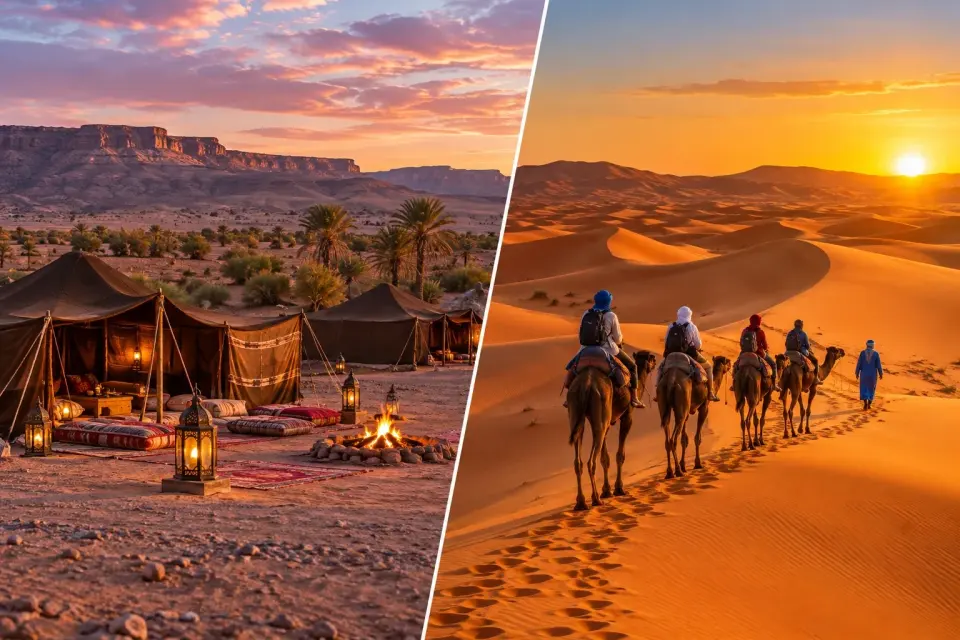
Start with the route, not with the question “Which desert is better?”
M’Hamid and Merzouga are both gateways to Morocco’s Saharan landscapes, but they solve different travel problems. Merzouga sits beside Erg Chebbi and works naturally on itineraries linking Fes with the Ziz Valley and the southern valleys. M’Hamid sits at the end of the Draa Valley road and is the stronger base when the journey itself is about walking, reaching Erg Chigaga, or spending more time in the south.
The most useful comparison therefore begins with where you start, where you finish and how many days you have. A traveler leaving Fes for Marrakech may find Merzouga efficient. A traveler leaving Marrakech specifically for a multi-day desert trek may find M’Hamid more coherent. Choosing by dune photographs alone ignores half the itinerary.
This rewrite deliberately avoids calling one destination “more authentic.” Tourism exists in both places, and a meaningful experience depends on the guide, camp, pace and route. The decision should be practical first, experiential second.
Merzouga and Erg Chebbi: why the classic Sahara route works

Merzouga is closely associated with Erg Chebbi, the large dune field on Morocco’s eastern desert route. The Moroccan National Tourist Office presents the Errachidia–Midelt–Merzouga region as the meeting point between the Atlas and the desert; its official Merzouga destination page is useful background when planning the eastern route.
The practical strength of Merzouga is access. Travelers can arrive by road, reach hotels or desert camps relatively easily, and choose among many accommodation standards. This makes the region suitable for first-time desert visitors, families, couples wanting comfort, or itineraries where the desert is one important section rather than the main purpose of the entire trip.
Merzouga is also a strong geographic bridge between Fes and Marrakech. The route can continue west through Erfoud, Tinghir, Todra, Dadès and Aït Ben Haddou instead of returning the same way. That flow often matters more than the fact that Erg Chebbi is famous.
M’Hamid: a base for walking and the Draa Valley route

M’Hamid El Ghizlane sits at the southern end of the paved road through the Draa Valley. The surrounding desert is not one continuous wall of high dunes. Routes can cross sandy areas, dry riverbeds, tamarisk zones, stony ground and open plains before reaching larger dune systems such as Erg Chigaga.
That variety is particularly important for trekking. Walking several days in the desert is not about repeating the same dune view. A good route changes terrain, uses shade intelligently and allows the guide to choose the day according to wind, temperature and the group’s condition. The official Moroccan tourism desert-and-oasis material provides broader context for the country’s southern desert regions; see the Morocco desert and oasis guide.
M’Hamid therefore makes most sense when you are willing to spend time entering the desert rather than expecting the largest dunes immediately after leaving the vehicle.
Desert camp and desert trek are different products
A camp-based stay usually prioritizes the night: arrival, dunes, sunset, dinner, stars, sleep and departure. That can be exactly right for a short itinerary. A desert trek prioritizes the hours between camps. Walking becomes the main activity and the itinerary must account for heat, water, shade, terrain, luggage support and the physical level of the travelers.
This distinction matters more than the M’Hamid-versus-Merzouga debate itself. You can have a quiet, carefully planned camp near Merzouga, and you can have an ordinary commercial camp near M’Hamid. Destination names do not guarantee the quality of the experience.
Before booking, ask how many hours you actually walk, whether luggage is carried separately, whether a vehicle can support the route, what type of shelter is used, how water is managed and whether the trip is designed around your group or a fixed circuit.
Erg Chebbi and Erg Chigaga: compare access as well as dunes
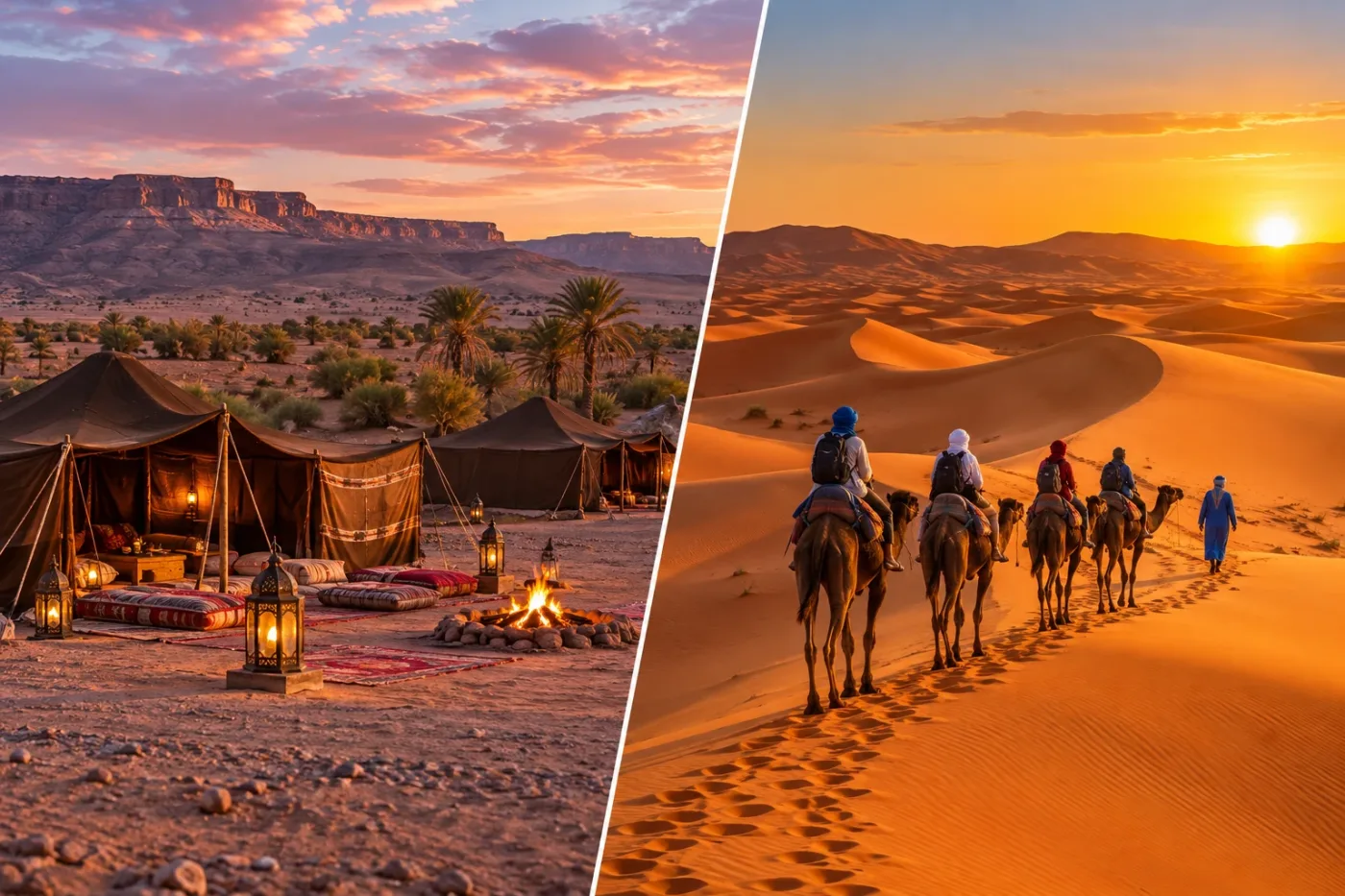
Erg Chebbi’s advantage is immediacy. The dunes rise close to Merzouga, so a traveler with limited time can reach a dramatic sand landscape without a long off-road approach. That is useful for photographers, families and travelers who want a strong visual desert experience within a broader Morocco itinerary.
Erg Chigaga is normally approached from the M’Hamid side and requires more time, often including off-road travel or trekking. The extra access is not automatically better, but it changes the experience: the route itself becomes part of the desert section rather than simply transport to a camp.
If you compare only dune height or photographs, you miss this operational difference. Erg Chebbi is easier to integrate. Erg Chigaga rewards travelers who intentionally allocate more days to the desert. The right choice depends on whether access time feels like a cost or an important part of the journey.
From Marrakech: M’Hamid often fits trekking better, Merzouga fits through-routes
Both desert gateways require a substantial journey from Marrakech. The first major change comes when the route crosses the High Atlas and enters southern Morocco. Aït Ben Haddou, Ouarzazate and the Draa Valley naturally lead toward Zagora and M’Hamid. This creates a coherent southern itinerary when the goal is a trek or Erg Chigaga.
Merzouga from Marrakech is also possible, but a very short out-and-back program can become dominated by driving. Merzouga works better when the trip continues north to Fes or when there are enough days to use Dadès, Todra and the desert as separate stages rather than rushed stops.
Whichever route you choose, do not treat the Atlas and kasbah country as empty transfer time. The UNESCO listing for Aït Ben Haddou is one useful reference for understanding the cultural landscape crossed on the way south.
From Fes: Merzouga usually makes more geographic sense

From Fes, the eastern desert route is far more direct. The road runs south through the Middle Atlas and toward the Ziz Valley before reaching the Merzouga area. That makes Erg Chebbi an efficient desert section in a Fes–Sahara–Marrakech itinerary.
Reaching M’Hamid from Fes is possible, but it requires a much larger southern movement. That can be worthwhile in a custom journey focused on trekking, but it is rarely the simplest choice for a traveler who only has a few days between Fes and Marrakech.
This is why destination comparisons should never be separated from the start and end cities. The same traveler may choose Merzouga on one Morocco trip and M’Hamid on another, simply because the overall route has changed.
Families: comfort, heat and road time matter more than labels
Families often do well in Merzouga because accommodation choice is broad and the classic dune-and-camp experience can be kept relatively simple. Short camel rides, dune play and one night in camp can work for children when the schedule is not overloaded.
M’Hamid can also be excellent for adventurous families, but a real trek must be adapted to age and walking tolerance. Shorter stages, vehicle support, shade, food preferences and sleeping arrangements should be discussed before the trip. A family trek should not simply be an adult program with fewer kilometers.
With either destination, private transport usually improves the experience because stops can be adjusted. The strongest family itinerary is the one that protects rest and avoids combining a very long road day with an ambitious evening program.
Couples and photographers: decide whether you want immediacy or space
Erg Chebbi is efficient for classic desert photography because the dunes are accessible and the shapes can be dramatic at sunrise or sunset. Couples who want a comfortable camp and one visually strong desert night may be satisfied with a carefully chosen Merzouga stay.
M’Hamid and Erg Chigaga suit travelers who want more time around the desert journey itself. For photographers, that can mean camp life, walking, changing terrain and several light windows instead of one sunset and one sunrise. For couples, it can mean a more private itinerary with fewer scheduled activities.
Neither result comes automatically from the place name. A large camp can feel busy in any desert region; a small private route can feel quiet in either. Ask how many tents there are, what vehicle access exists and how the camp is positioned relative to other camps.
Season: October to spring is easier for walking, but nights can be cold
Desert walking is sensitive to temperature. Autumn, winter and spring generally offer more comfortable daytime conditions than the hottest months, while winter nights can be surprisingly cold. The Moroccan National Tourist Office’s climate and seasons guidance is a useful starting point for broad planning.
Summer does not make every desert trip impossible, but it changes what is realistic. Long trekking days need much more caution, and activity may have to be concentrated in early morning and late afternoon. For a short camp stay, summer planning is different again because less time may be spent walking.
Check conditions shortly before travel and discuss the actual daily plan with the operator. A month name alone does not tell you the wind, temperature or route conditions you will encounter.
Comfort and camp standards vary more than destination marketing suggests
Merzouga has a wide range of accommodation and camp styles, from simple guesthouses to high-comfort tents. M’Hamid and Erg Chigaga also offer different standards, but remote access can make logistics more significant. A “luxury” label is not enough information.
Ask about private bathrooms, bedding, heating or extra blankets in winter, electricity, charging, luggage transfer, meal arrangements and how far the camp is from vehicle access. On a trek, ask whether the bivouac is fixed or moves with the route.
These details matter because comfort and remoteness can pull in opposite directions. Some travelers want a private bathroom and hot shower; others are happy with simpler conditions if it allows a better walking route. Decide which trade-off matters to you.
The most useful comparison: who each destination fits
Choose Merzouga when the route starts or ends in Fes, when you want Erg Chebbi’s large dunes with simpler access, when family comfort is important, or when the desert is one stage inside a wider Morocco circuit. It is also convenient for travelers who want a short, visually strong camp experience.
Choose M’Hamid when the main goal is multi-day walking, Erg Chigaga, a route through the Draa Valley or a desert section that deliberately takes more time. It is particularly suitable when you start from Marrakech and want southern Morocco to form the spine of the trip.
Do not use this as a ranking. A traveler seeking trekking may find Merzouga too camp-focused; a traveler with two children and limited time may find a long M’Hamid trek unnecessary. Fit is more useful than prestige.
Questions to ask before paying a deposit
Ask for the approximate road time on every transfer day and the actual walking hours on trekking days. Ask whether the route is private, how many guests share the camp, which meals are included and whether activities are confirmed or optional.
For M’Hamid and Erg Chigaga, clarify the 4x4 or trekking access and what happens to your luggage. For Merzouga, clarify the exact camp location and whether the camel ride is a short transfer or a longer outing. For both, ask what changes if wind or temperature makes the original plan uncomfortable.
Finally, read the exclusions. Desert pricing can look similar while including very different transport, camp, guide and meal standards. A clear quotation is more useful than a low headline price.
A practical decision in 60 seconds
If you are coming from Fes and continuing to Marrakech, start by looking at Merzouga. If you are coming from Marrakech and your main goal is a multi-day trek, start by looking at M’Hamid. If you only have two or three days, reduce expectations before choosing either destination.
If large dunes and an easy camp arrival matter most, Erg Chebbi is the straightforward option. If walking, terrain variety and a longer desert approach matter more, M’Hamid and Erg Chigaga deserve more attention.
Then check season, family needs, comfort level and the number of road days. Those four factors usually settle the decision more reliably than social media photos.
Plan the desert as part of Morocco, not as a separate attraction
The strongest Sahara journeys begin before the sand. From Marrakech, the High Atlas, Aït Ben Haddou and Draa Valley prepare the traveler for M’Hamid. From Fes, the Middle Atlas and Ziz Valley prepare the traveler for Merzouga. This transition is part of why the route matters.
DesertBrise can build either type of journey. The purpose is not to force one gateway. It is to match the desert to the rest of the itinerary, the travelers’ energy and the amount of time available.
That approach also keeps the comparison honest: M’Hamid is not automatically “more authentic,” and Merzouga is not automatically “too commercial.” Both can be excellent when planned around the right traveler.
Packing and preparation differ between a camp stay and a trek
For a one-night camp, most travelers need little more than layered clothing, sun protection, a small overnight bag and something warm for the evening. A multi-day trek requires more attention to footwear, socks, personal medication, a compact day bag and how luggage will be transported.
Do not assume the desert is always hot. Wind and clear winter nights can make temperatures feel much lower than expected. Conversely, heavy clothing is a burden during warm walking hours, so layers work better than one bulky item.
Ask the operator what sleeping equipment is provided and what you should bring yourself. Packing advice should match the actual month and itinerary rather than a generic Sahara checklist.
Two realistic route examples make the choice clearer
Example one: you land in Fes, want to cross the country to Marrakech, and have four or five days for the desert section. In that case, Merzouga is usually the cleaner fit. You can leave Fes, cross the Middle Atlas and Ziz Valley, spend meaningful time around Erg Chebbi, then continue through Tinghir, Todra, Dadès and Aït Ben Haddou toward Marrakech. The desert becomes a bridge between two cities instead of a detour that forces you back over the same ground.
Example two: you begin in Marrakech and the main reason for the trip is walking in the Sahara. Here M’Hamid often makes more sense. The route can move through the High Atlas, Aït Ben Haddou and Ouarzazate, then follow the Draa Valley south. Once in M’Hamid, the journey can shift from road travel to a two-, three- or four-day trek. That gives the desert enough time to become the center of the itinerary instead of one night between driving days.
These examples are not fixed templates. A traveler can visit Merzouga from Marrakech or M’Hamid from Fes, but the trade-off is extra road time. When building a private trip, we calculate whether that extra movement adds value. If it does not, we change the gateway rather than forcing the original idea.
Flight airports matter too. An open-jaw itinerary—arriving in one city and leaving from another—can save a full day of backtracking. This is especially useful when combining a desert route with Fes, Marrakech or Casablanca. The best Sahara choice is therefore partly a flight-planning decision, not just a dune decision.
One final rule is useful: protect at least one unhurried morning or afternoon in the desert region. That buffer gives you room for weather, photography, rest and simple time outside the vehicle, which is often what travelers remember most.
That final buffer also protects the trip from small delays on mountain roads or at lunch stops. Ten flexible minutes here and there matter less when the desert section is not built around a single rushed sunset.